
Will Your Coffee Brewer Fit Your Travel Mug?
A travel mug can hold your coffee without being a suitable place to brew it. Before a trip, check how your exact brewer meets the receiving vessel: what must fit inside the opening, what rests on the rim, and whether the vessel is suitable for the method. If any part is uncertain, brew into an existing compatible receiver and transfer the finished drink, or keep your familiar cup. A new mug is not automatically necessary.
The useful question is not simply “Does it fit?” It is “Does this complete combination meet the maker’s instructions without an improvised support?” That distinction matters when a wide mug swallows a brewer’s support flange, a narrow mouth blocks the outlet, or a lid collar stops the base from sitting as intended.
First identify the interface you actually need
Set aside capacity for a moment and identify the arrangement described in your brewer’s instructions. Some brewers sit on a cup and drain by gravity. Others also require the cup to support the brewer during pressing. A machine may instead collect coffee in its own cup or need a receiving vessel under a fixed outlet. These are different compatibility questions; a rule for one arrangement cannot answer all four.
For a cup-supported brewer, both the opening and the bearing surface matter. For a receiver under an outlet, height, clearance and the intended coffee path matter. For a brewer with its own collection cup, check whether direct brewing into another vessel is supported at all. Do not remove a component or suspend a device above your mug merely because the two look close in size.
Write down the exact model and any accessory that changes the interface. A different filter cap, stand or mug insert can change the combination you are checking. Use its manufacturer’s current instructions, not an image of a similar model. If the instructions specify a dedicated receiver, that is your starting point.
Measure the opening, not the outside of the mug
A mug’s advertised volume does not tell you its opening size. Neither does its widest outer dimension. With the mug cool and empty, measure across the inside of the opening at the level where the brewer would meet it. Record the unit. If the manufacturer defines a different measurement point, follow that definition instead.
A rolled lip, thick ceramic wall or recessed collar can make the useful opening smaller than the top looks. An oval mouth needs attention in both directions; a single large measurement across its long axis does not establish circular-brewer compatibility. Do not treat a decorative outside rim as usable support without checking the actual contact surfaces.
As a bounded example, AeroPress specifies a top inner diameter from 2.75 to 3.75 inches, or 70 to 95 millimeters, for its Original and Clear models. Those numbers are useful because they identify both the measurement and the models. They are not a universal range for other brewers, other AeroPress models or alternative accessories.
Suppose an empty mug measures 68 millimeters inside its top opening. In that specific example it falls below the stated minimum, even if its outside width is 80 millimeters. The outside measurement cannot rescue the pairing. If your reading is close to a limit or varies around the rim, resolve the uncertainty with the maker rather than rounding toward a fit.
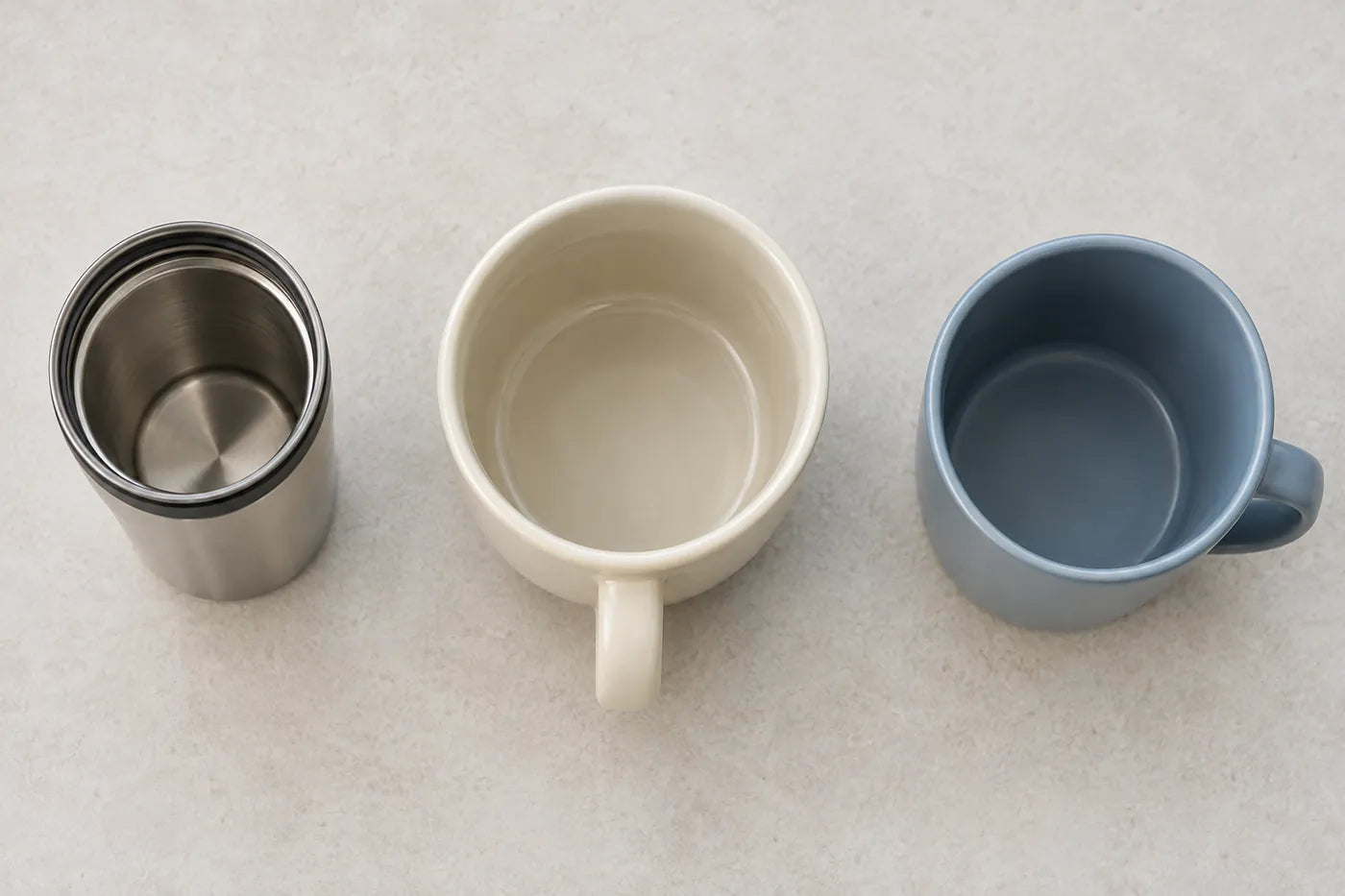
Opening size is only one part of compatibility
Next look at the surfaces that would meet. Does the brewer sit in the position its instructions show, or is an unrelated feature touching first? A raised drinking spout, handle joint, thread or collar may prevent proper seating. A base that appears wide enough from above may contact only a small or sloping part of the rim.
Use a cool, empty visual fit check only where the intended assembly is supported by the instructions. Do not push, press, heat or fill an uncertain pairing to discover whether it works. Rocking, tilted contact, a blocked outlet, or the need to hold the brewer in place are reasons to stop using that pairing, not invitations to add a towel, makeshift bridge or improvised adapter.
Material suitability is a separate check. AeroPress’s glass-carafe guidance allows glass for Original, Premium and Clear only when it is sturdy, rejects thin or delicate glassware, and says not to press the XL into any glass mug or carafe. This example shows why a vessel that accepts the brewer geometrically can still be inappropriate. It does not certify any unlisted glass vessel or another maker’s equipment.
An empty check can reveal an obvious mismatch; it cannot prove load capacity, heat resistance or suitability during brewing. Appearance is not a material rating. Where compatibility remains unclear, use a known supported receiver or ask the manufacturer about the exact combination before departure.
Choose a route before packing
| What you establish | Practical route | Tradeoff |
|---|---|---|
| Exact instructions support the mug and interface; fit is unobstructed | Use the supported direct-brewing arrangement | Fewer vessels, but the mug must satisfy all relevant requirements |
| Travel mug is unsuitable as a brewing receiver; an existing compatible receiver is available | Brew in that receiver, then transfer if both vessels permit it | One extra vessel and transfer step |
| No compatible receiver is available or instructions remain unclear | Keep a different familiar setup, choose a supported alternative, or defer brewing | Your preferred mug or method may stay home |
Direct brewing is convenient when the combination is supported, but it is not a goal worth forcing. A transfer route can let you keep a comfortable travel mug whose narrow mouth makes it a poor brewing support. Conversely, if an extra receiver makes the kit awkward, drinking from the compatible cup you already own may be the simpler choice.
Check the receiver and transfer options before deciding whether any equipment needs replacing. If a replacement vessel really is needed, shop against the exact requirements you have established. A label such as “travel,” “camping,” or “large” tells you little about a particular brewing interface.
Make the transfer option usable
Separate the receiving job from the drinking job. The first vessel must be suitable for your brewer and its output; the travel mug must be suitable for the finished drink and filling method. Confirm usable capacity and the mug’s specified filling limit independently of rim fit. Enough opening clearance does not mean enough room for the drink.
Choose an existing receiving vessel that can also transfer the drink in the manner its maker allows. Check the handle, spout or intended pouring edge and whether you can approach the travel mug’s opening without an awkward angle. An extra container with no practical pouring route may merely move the original problem to a different step.
At home, with no brewer involved, a small amount of cool drinking water can help you notice an awkward transfer between vessels intended for liquids. Keep both on a clear surface and do not overfill them. This is a pouring rehearsal, not evidence that either vessel can withstand a brewing load or hot liquid. If transfer is clumsy, keep the coffee in the compatible drinking vessel instead.
Allow space to set the receiver down before replacing the travel mug’s lid according to its instructions. Avoid a plan that depends on holding a mug, balancing a receiver and finding the lid at the same time. The extra item also needs packing space and later cleaning; include those costs when deciding whether transfer actually makes your stop easier.
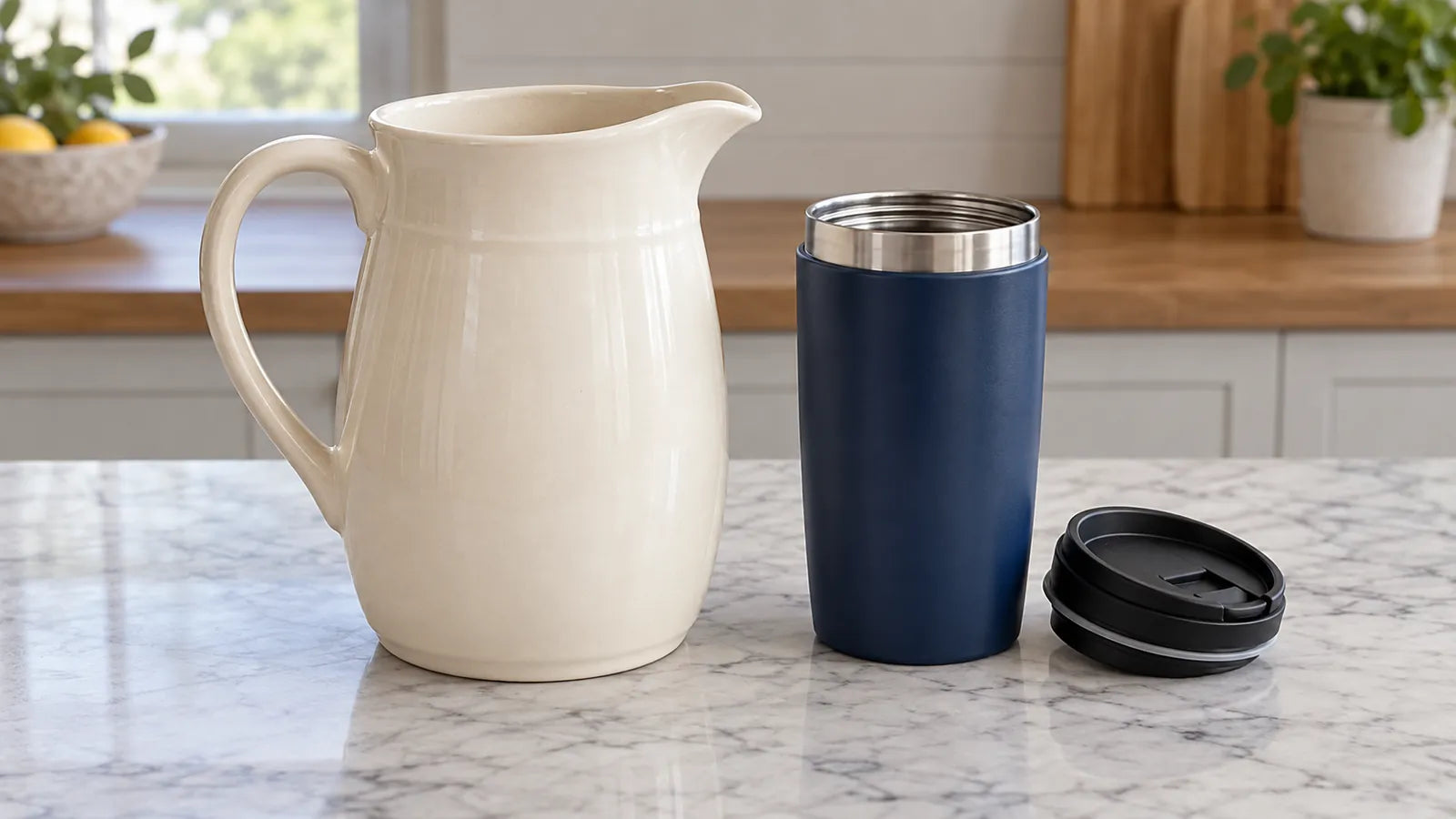
Resolve the pairing at home, then check the stop
Take the exact mug and brewer components you checked, not a visually similar substitute. A photograph of the chosen items beside each other can be a simple packing reminder, but you do not need a complicated equipment log. Keep the relevant model instructions available if a component name or limitation is easy to forget.
At the stop, confirm that the table or other permitted surface supports the complete arrangement and leaves room to handle the vessels normally. Our outdoor coffee-stop site-selection checklist covers the separate location decision. A cup-and-brewer match established at home does not make every campsite surface suitable.
If the available setup differs materially from your plan, return to a simpler supported arrangement or skip brewing there. Keeping your original cup can be a successful outcome: the point is a workable coffee stop, not making every piece in a travel kit connect directly.
Frequently asked questions
Does fitting inside the mug for storage mean the brewer can brew on it?
No. Nesting checks transport space; brewing checks a working interface, support and applicable material requirements. Evaluate those separately. A brewer may pack neatly inside a mug that is unsuitable as its receiving support.
Can I compare two mug sizes from photographs?
Use photographs to identify features worth checking, not to establish dimensions. Perspective, wall thickness and hidden collars can mislead. Obtain the relevant measurements and exact compatibility information before treating either mug as a match.
What should I send a manufacturer when the answer is unclear?
Provide the brewer model, fitted accessory, mug make and model, relevant opening measurements with units, and clear pictures of the rim and intended contact area. Ask whether that exact combination is supported. A general “Will this work?” without model details is harder to answer reliably.
Should I file down a lip or use a homemade support?
No such modification is part of this guide. Choose a supported receiver, transfer the finished coffee where appropriate, or keep another familiar setup. An unresolved interface is a reason to change the pairing rather than alter equipment speculatively.
Source and illustration note: Manufacturer examples were read September 30, 2026 and apply only to the named models. The decision framework is a planning aid, not a compatibility certification or first-party test. All three images are generated illustrations; the pictured portable machine is shown closed and separate from the mug, without a direct-brewing claim.